

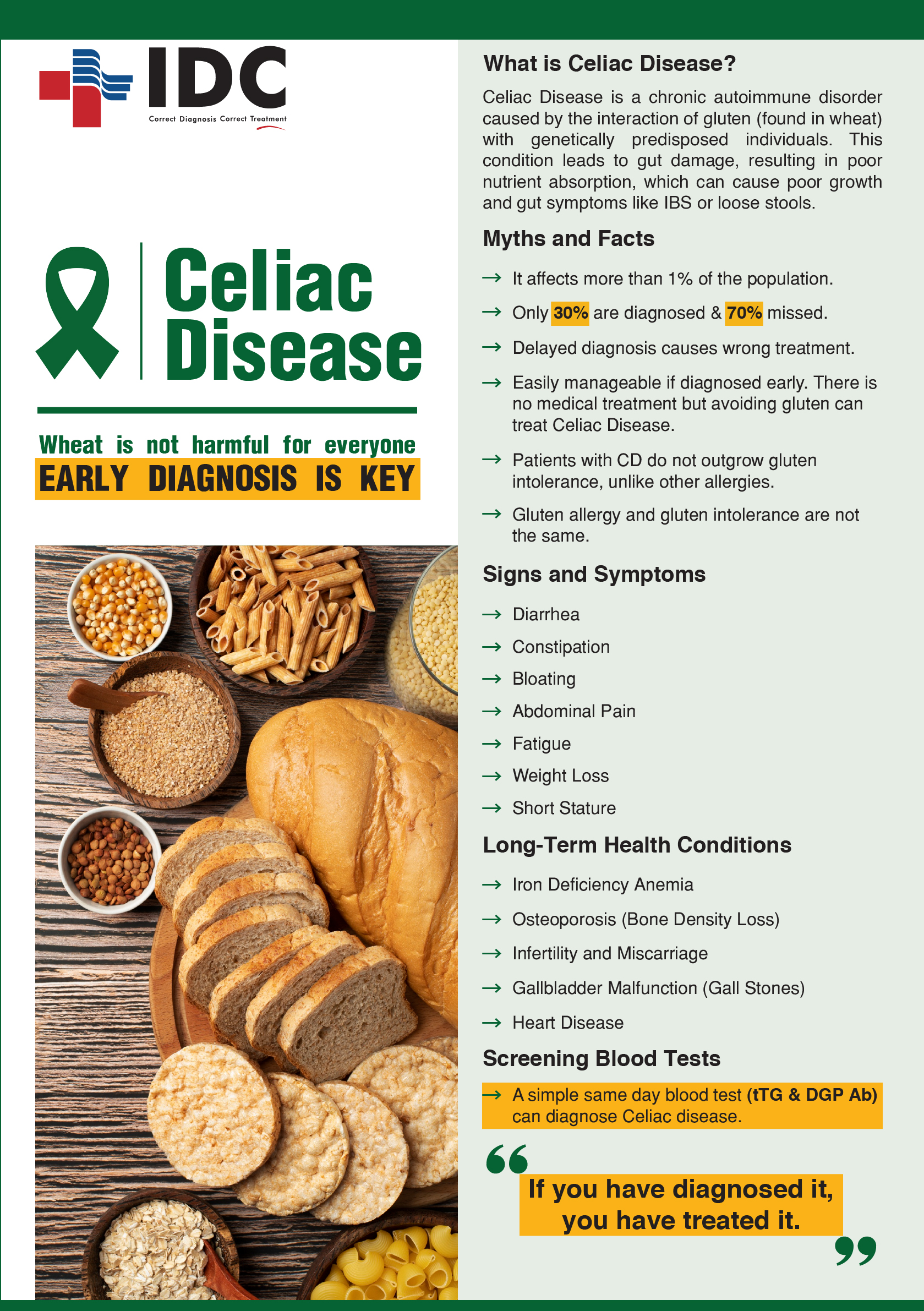
 Disease Testing at IDC (ISO15189:2022 Accredited Laboratory) – Comprehensive Serological Diagnosis Using Advanced CLIA Technology
Celiac disease is a chronic autoimmune disorder triggered by gluten ingestion in genetically susceptible individuals. Early and accurate diagnosis is essential to prevent long-term complications including malabsorption, nutritional deficiencies, osteoporosis, infertility, and increased risk of intestinal lymphoma. At Islamabad Diagnostic Centre (IDC), comprehensive celiac disease serology is performed using advanced Chemiluminescent Immunoassay (CLIA) technology, providing highly sensitive, specific, and reproducible results. IDC offers a complete antibody profile including Tissue Transglutaminase (tTG) IgA & IgG and Deamidated Gliadin Peptide (DGP) IgA & IgG for accurate diagnosis across a broad spectrum of patients, including those with selective IgA deficiency.
Why IDC’s Celiac Disease Testing is Different
Complete celiac antibody profile including Tissue Transglutaminase (tTG) IgA & IgG and Deamidated Gliadin Peptide (DGP) IgA & IgG.
Testing performed on advanced Chemiluminescent Immunoassay (CLIA) technology.
CLIA provides high analytical sensitivity, specificity, wide dynamic range, and excellent reproducibility.
Automated testing minimizes manual handling and improves consistency and turnaround time.
Comprehensive antibody assessment improves diagnostic confidence in both adults and children.
Expert interpretation under stringent internal quality control procedures.
Benefits of CLIA Technology
Higher analytical sensitivity than conventional ELISA methods, supporting detection of lower antibody concentrations.
Excellent specificity with reduced analytical variability.
Fully automated workflow for consistent, standardized results.
Rapid processing with improved laboratory efficiency.
Reliable monitoring of antibody levels during follow-up of patients on a gluten-free diet.
Clinical Applications
The celiac antibody profile supports the evaluation of patients with chronic diarrhea, abdominal pain, bloating, unexplained iron deficiency anemia, weight loss, malabsorption, osteoporosis, recurrent miscarriage, dermatitis herpetiformis, unexplained elevation of liver enzymes, type 1 diabetes mellitus, autoimmune thyroid disease, Down syndrome, and individuals with a family history of celiac disease. Combined assessment of tTG IgA & IgG and DGP IgA & IgG improves diagnostic accuracy, particularly in patients with IgA deficiency or atypical clinical presentations.
Why Choose IDC?
IDC is ISO15189:2022 accredited laboratory.
Advanced CLIA-based celiac disease testing.
Complete antibody profile in a single diagnostic panel.
High-quality automated laboratory platform.
Experienced pathologists and laboratory professionals.
Accurate, reliable, and clinically actionable reports.


